Building orgs through ambiguity, scale and change
Some of my most meaningful work wasn't building products—it was building the organizations that built them. I helped teams navigate ambiguity, align around strategy, improve operating models, and sustain momentum through periods of rapid change. These efforts rarely produced a single launch, but often created the conditions that enabled many successful ones.
Impact at a glance
TEAM
Guided teams through multiple periods of org change without missing deliverables or experiencing management-driven attrition.
Strengthened collaboration across disciplines and established operating mechanisms that improved visibility, alignment, and execution.
ORG
Provided continuity through leadership transitions, reorganizations, and strategic pivots while helping shape strategy and execution across multiple product areas serving billions of annual post-click sessions.
Leadership
Served on multiple leadership teams simultaneously, influencing strategy, roadmaps, org effectiveness, and design investment decisions.
Expanded the role of CD beyond execution and into org leadership, operational strategy, and cross-functional influence.
Overview
At Meta, organizational complexity often rivaled product complexity. Teams spanned products, functions, and leadership structures while priorities evolved rapidly. Over time, I became increasingly focused on improving how teams aligned, communicated, and executed—viewing organizational effectiveness as one of the highest-leverage forms of design leadership.
CONTEXT
Organizational challenges rarely appear as a single problem. They emerge as unclear ownership, misalignment, recurring friction, or slowed execution. The challenge was identifying the root causes and creating systems that helped teams move faster, collaborate more effectively, and make better decisions.
TENSION
I regularly operated beyond traditional Content Design leadership—building alignment across organizations, improving operating models, clarifying decision-making, and helping teams translate strategy into execution. My focus was simple: strengthen the systems that allow great teams to do their best work.
Building alignment across organizations
Designing operating models and communication frameworks
Supporting teams through change and leadership transitions
Clarifying ownership and decision-making
Translating strategy into execution
Coaching leaders and designers through ambiguity
ROLE
Deep dive
-
PROBLEM
Near the end of H1 2025, the organization experienced a period of significant disruption. Leadership transitions, a major reorganization, and multiple departures reduced design leadership capacity from eight leaders to two, creating risk to execution, alignment, and team morale at a critical moment.
COMPLEXITY
The challenge extended far beyond staffing. Priorities were shifting, teams required direction, and execution commitments remained unchanged despite dramatically reduced leadership capacity. Maintaining momentum required new operating models, faster decision-making, and broader leadership coverage across the organization.
LEADERSHIP CONTRIBUTION
I partnered closely with Design, Product, and Research leaders to maintain continuity and organizational stability. I increased transparency around priorities, created new leadership structures to support a larger scope, and empowered senior ICs to help translate strategy, surface risks, and maintain momentum across teams.
OUTCOME
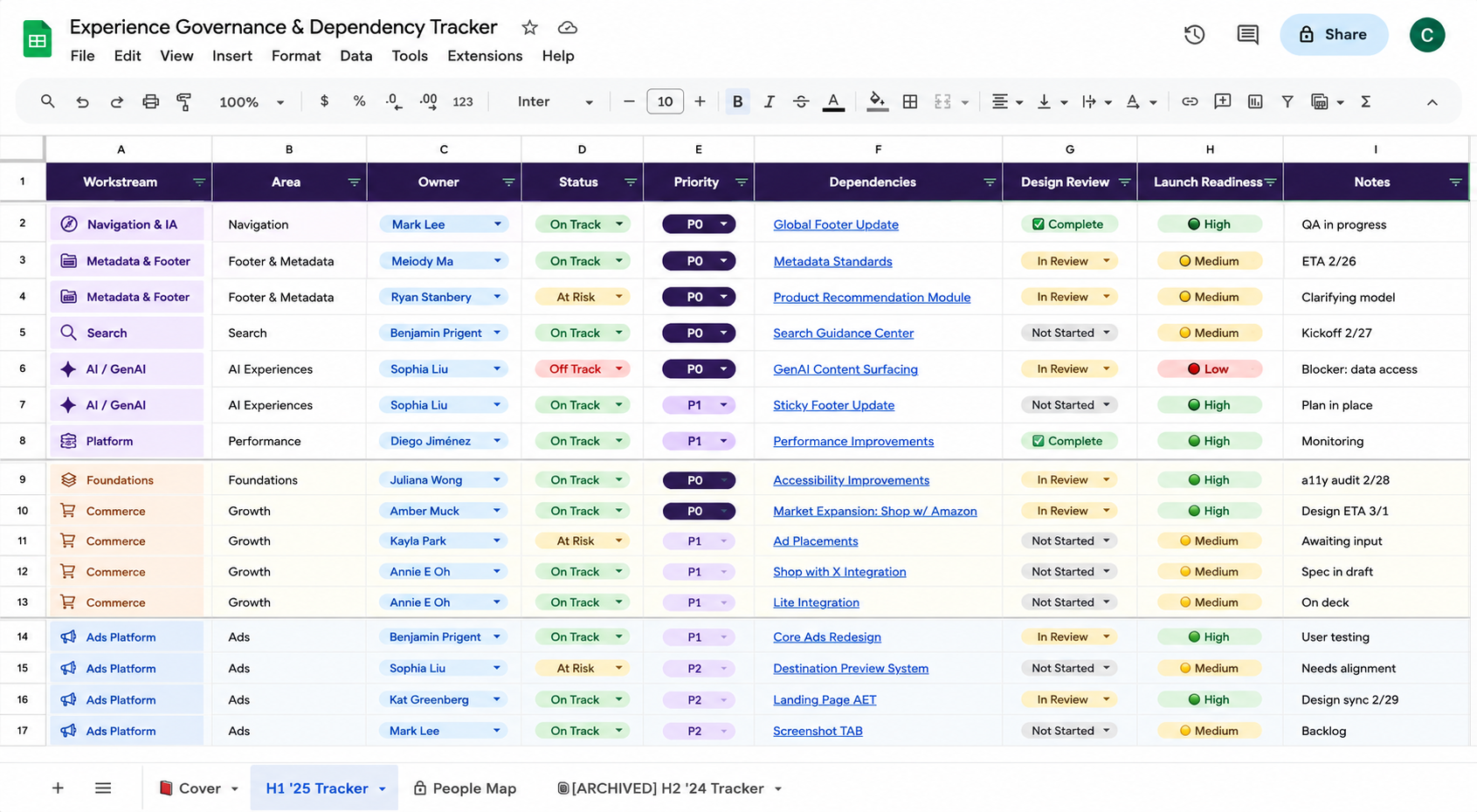
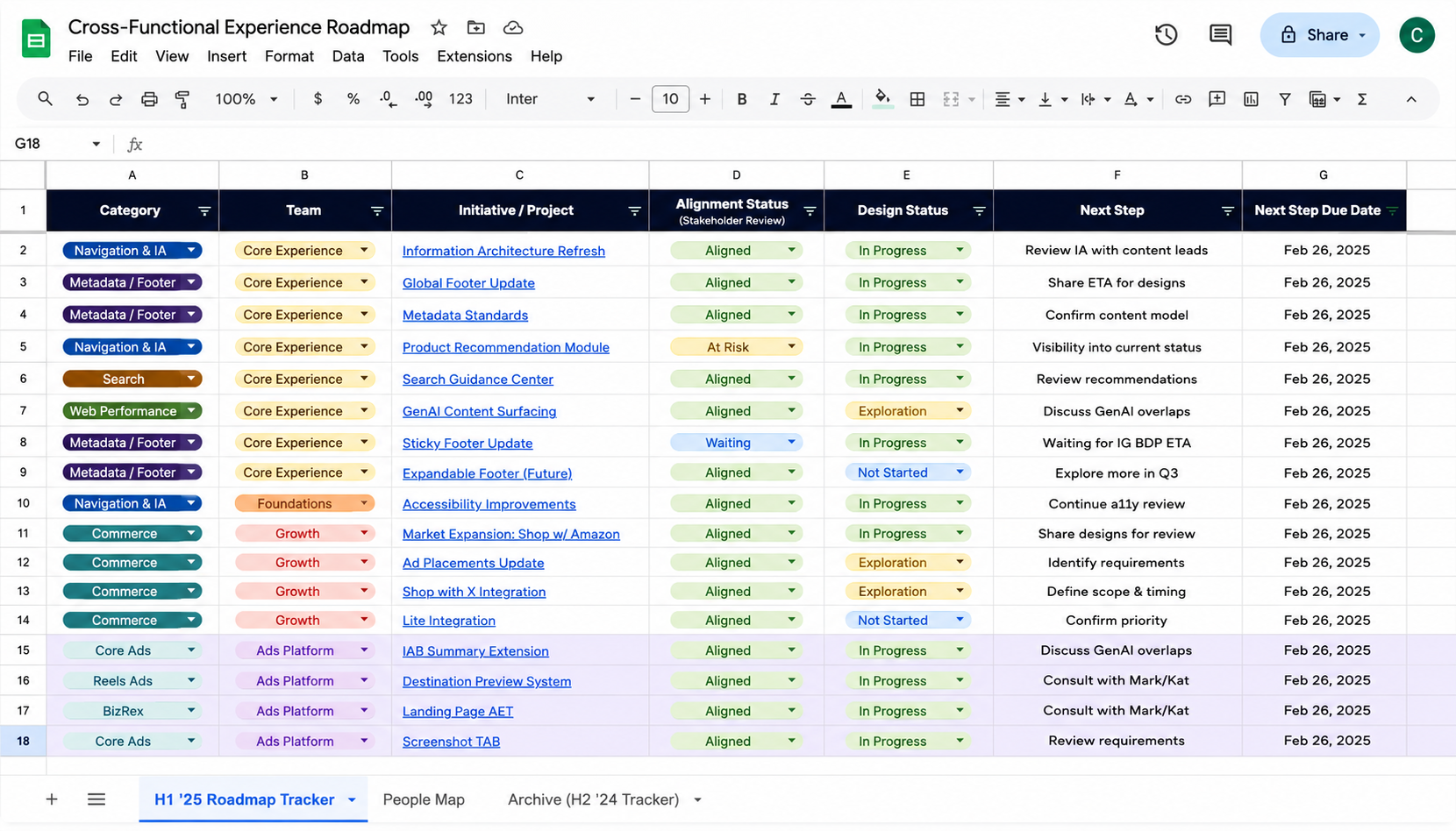
I established new operating mechanisms that improved visibility, strengthened decision-making, and maintained design quality despite reduced leadership capacity. The organization delivered against revenue commitments, maintained execution momentum, and successfully navigated a period of significant change without major disruption to product delivery.
-
PROBLEM
As the organization evolved, many of the most important challenges were no longer product problems—they were organizational ones. Teams needed clearer ownership, stronger planning processes, improved collaboration, and better systems for maintaining quality at scale.
COMPLEXITY
Organizational systems are difficult to change because they sit at the intersection of people, process, and incentives. Teams operated across products and organizations with different priorities, making alignment, ownership, and visibility ongoing challenges that required thoughtful, scalable solutions.
LEADERSHIP CONTRIBUTION
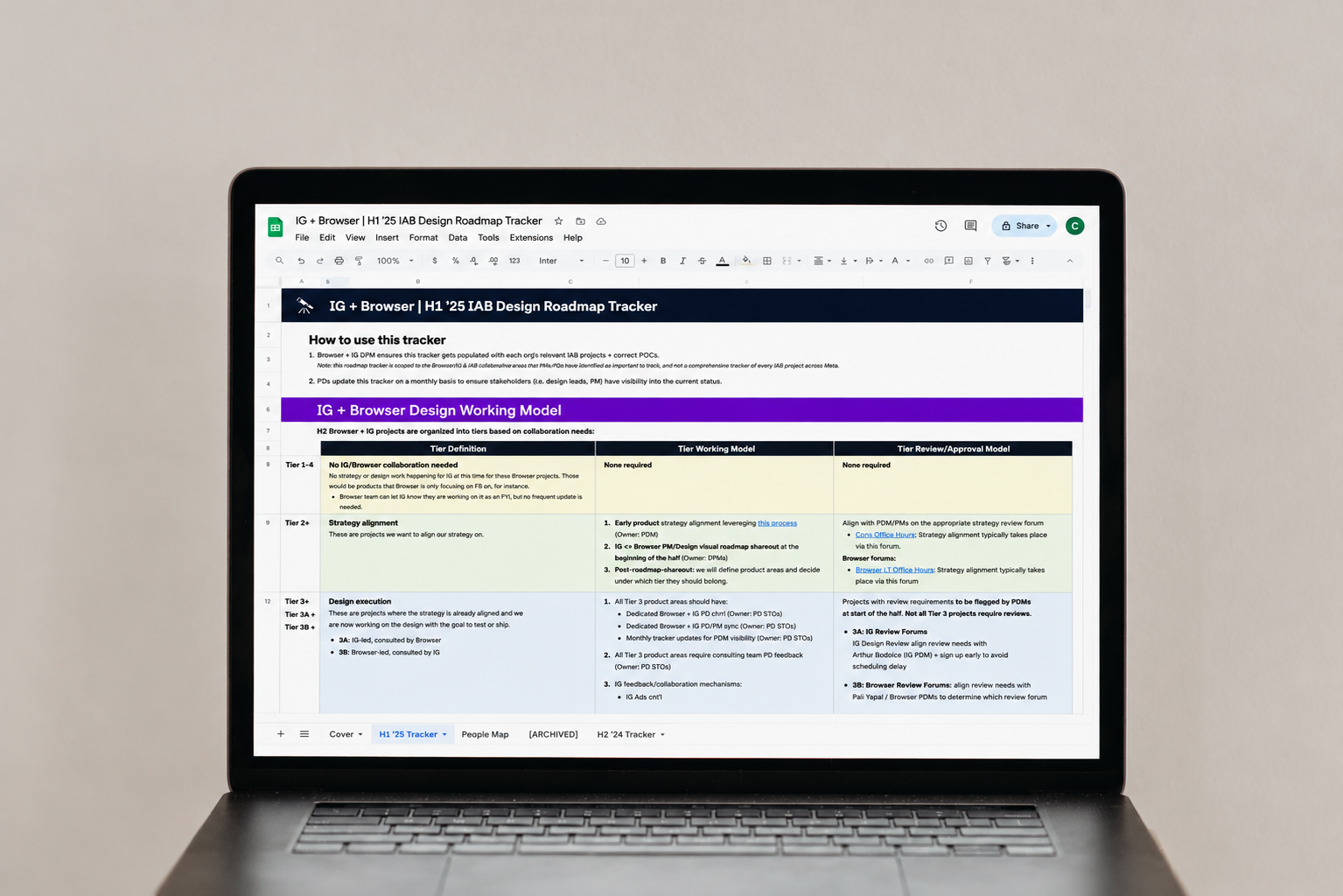
I increasingly viewed the organization itself as the system to be designed. My work focused on improving communication, clarifying ownership, strengthening collaboration, and building repeatable planning frameworks that helped teams move more effectively from strategy to execution.
OUTCOME
I helped establish repeatable operating models that improved organizational effectiveness at scale. This included the Divergent Design Framework for design decisions, the pillar's first UX roadmap, cross-organizational collaboration frameworks, and durable ownership principles that reduced friction and improved execution across teams.
-
PROBLEM
As teams expanded and products became more complex, designers were increasingly expected to operate beyond craft execution. Success required strategic thinking, cross-functional influence, and the ability to navigate ambiguity. A significant part of my leadership focused on helping designers develop those capabilities.
COMPLEXITY
Developing leaders is rarely about teaching a single skill. Designers needed to balance product execution with strategy, influence without authority, and adapt to evolving organizational priorities—all while continuing to deliver at a high level during periods of rapid change.
LEADERSHIP CONTRIBUTION
I focused on helping designers think more strategically, operate with greater independence, and build stronger cross-functional relationships. My approach emphasized creating clarity amid ambiguity, encouraging systems-level thinking, strengthening partnerships across disciplines, and investing deeply in career growth and long-term development.
OUTCOME
Over time, I came to believe that the most effective way to scale design impact was through other people. I successfully promoted approximately half of my direct-report roster, maintained 97–98% Pulse manager scores, strengthened cross-functional relationships across teams, and helped the organization navigate multiple reorganizations without management-driven attrition or missed critical deliverables.
“Chris took the initiative to draft a tiered working model that served as the strategic foundation for our partnership…”
Lessons
Org health is a prerequisite
Strong design rarely happens by accident. Teams produce their best work when leaders create clarity, build trust, communicate openly, and establish environments where people can focus, collaborate, and grow. Org health is not separate from design quality.
Leaders build orgs, not just products
Great design leaders eventually spend more time designing organizations than designing products. They create alignment, establish operating systems, and remove friction that prevents teams from doing their best work. Product quality often becomes a byproduct of org quality.
Stability enables innovation
Stability enables innovation. During periods of uncertainty, leaders create value by communicating openly, building trust, and providing clarity. Teams innovate most effectively when they have confidence in the people and systems surrounding them.